Digital Economy: Reports of the death of software are greatly exaggerated
Fears that increasingly powerful artificial intelligence (AI) could undermine the dominance of large IT companies are keeping markets on edge. But is the software industry really doomed? Bertrand Born and Luca Menozzi have taken a closer look at this question – and despite all the concerns, they have identified compelling investment potential.
Bertrand Born Lead Portfolio Manager, and Luca Menozzi, Portfolio Manager

Key takeaways on the opportunities arising from AI-driven upheaval in the software sector:
- Fears about the “death of software” are exaggerated. However, Artificial Intelligence (AI) is radically reshaping the industry, and investors need to be highly selective.
- The sell-off in software stocks has created attractive value opportunities. While application software and IT services are genuinely disrupted, certain types of infrastructure software are seeing accelerating growth, thanks to AI.
- We see attractive, sustainable investment opportunities in AI across the four investment sub-themes: digital infrastructure, digital security and digital empowerment.
When Jensen Huang speaks, investors listen: the views of Nvidia’s CEO, whose company is a leading manufacturer of Artificial Intelligence (AI) computing chips, are seen as setting the tone for the entire technology sector. Yet one recent statement from Huang likely raised eyebrows in many quarters: “This is an incredible time to be a software company,” he declared at a recent industry event.
Why is AI turning the software industry upside down?
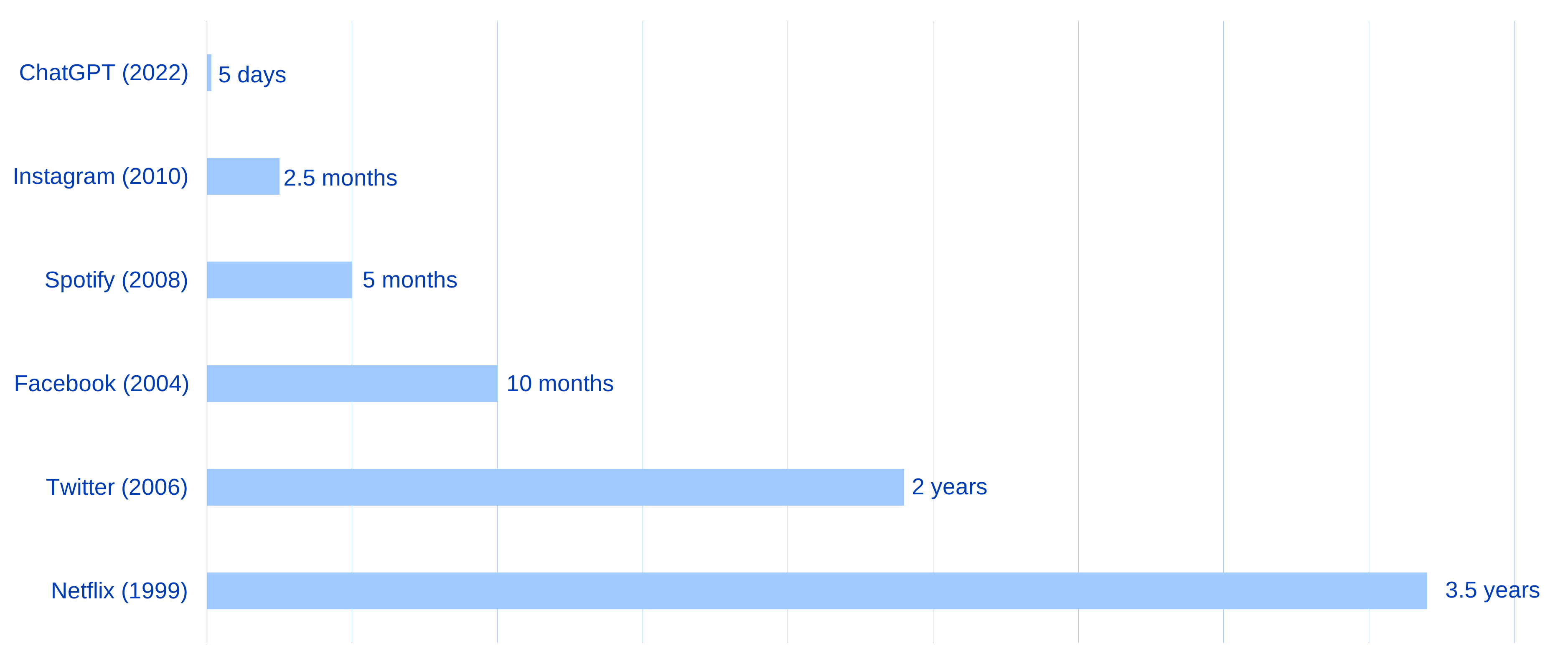
Great times? AI is conquering the market at breakneck speed: The AI model ChatGPT, for example, took just 5 days to attract 1 million users (see chart below). In doing so, it is also turning the software industry upside down. AI has an impact on several levels at once; in our view, the following are the most crucial:
- Substitution: some application use-cases get outright substituted by AI. For example, images can be described as prompt and generated by AI, requiring less image-creation software; languages can be learned by asking the AI to teach the user, requiring less specialized apps. AI can also analyse legal texts and accounting, reducing the need for legal and accounting software.
- Vibe coding: large language models are experts at language, and computer programming code is in essence a language. Accordingly, users can request the software they would like, and AI can program it better than a software engineer can in many basic cases. This reduces the barriers to entry to creating code, increases competition, and puts pressure on pricing.
- Business model disruption: beyond chat-bots, AI can autonomously perform tasks and complete processes in what is termed as Agentic AI. As human users of applications and data in a company get partially displaced or automated via AI agents, people-based "software seat" pricing models become obsolete and have to be restructured to consumption- or outcome-based business models. This puts in our view pressure on conventional "Software as as Service" (SaaS) and IT consulting business models.
All of the above factors are having an impact on the outlook of the software industry and have caused its stock prices to fall sharply. Last February alone, more than USD 1 trillion in market value temporarily evaporated; since then, markets have been gripped by fears of the “death of software.”
Rapid spread of AI models (time needed to reach 1 million users)
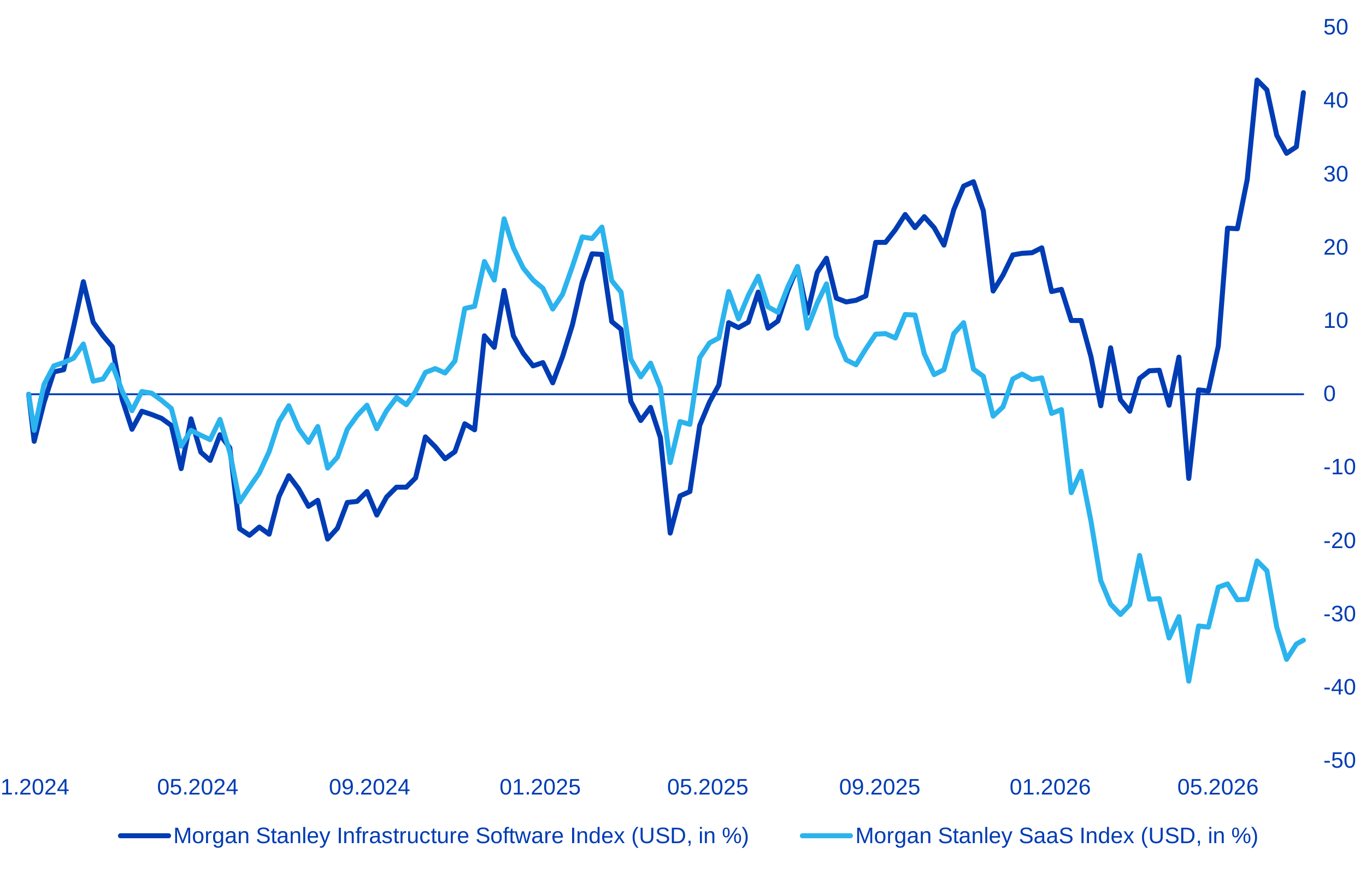
Investors have cautiously started circling around software stocks again. The software industry barometer S&P North American Expanded Technology Software Index, for example, has risen by more than 40% from its April lows, but has since given back most of its gains on mixed earnings results. Under the surface, the movements are more nuanced: Application software briefly rebounded but fell back once again as the AI disruption overhang remains. Meanwhile, infrastructure software has increased by around 45% (see the chart below).
To borrow a famous line often attributed to writer Mark Twain, reports of the death of software appear to have been greatly exaggerated.
Infrastructure software shares have been in high demand (performance in USD and %, indexed)
What should investors consider when navigating the AI-driven changes in the software industry?
We arrive at the same conclusion. Especially after the broad and in some cases unjustified sell-off in software stocks, we believe that there are attractive investment opportunities in many corners of the industry – including from a sustainable investment perspective. However, given the elevated volatility and dispersion in stock performance, we consider it more important than ever to navigate the upheaval unleashed by the AI boom with great care.
Investors also need to be highly selective and aware that not all software is the same. The level of AI disruption a company faces depends on where its business sits in the software stack – the higher up the orchestration layer, the higher the risk of disruption by AI. Conversely, the lower a business sits in the data layer, the more resilient it is to AI; in many cases, these businesses can even benefit from AI.
Where do we see sustainable investment opportunities in AI?
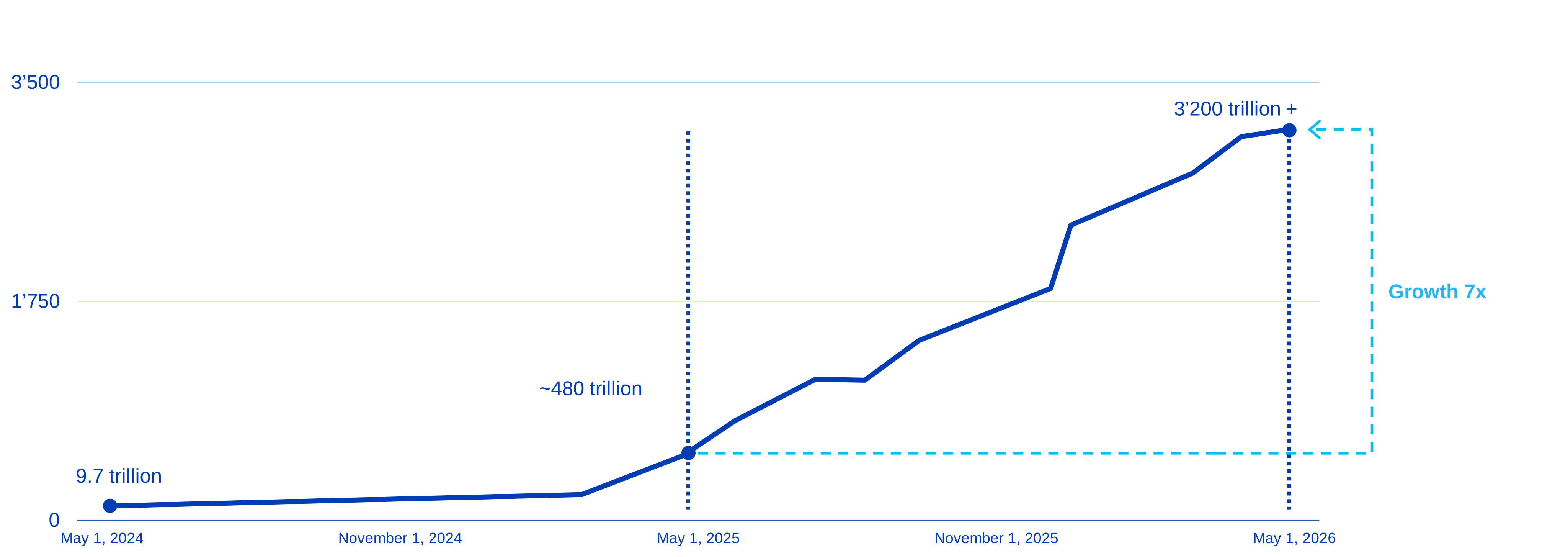
Moreover, the rapid growth of AI not only offers numerous opportunities for the software industry itself, but also for its suppliers, and related sectors of the economy. One example is the fact that this future-defining technology requires ever more computing capacity (see chart below), which in turn demands substantial investment in digital infrastructure. We also see significant potential in the areas of digital security and digital empowerment.
Computing-intensive AI (monthly processed request tokens at Google, in trillions)
In our view, companies in these thematic areas not only offer above-average growth potential, but with their products and services they can also help address the 17 UN Sustainable Development Goals (SDGs). At the same time, these are the subthemes of the structural trend toward a digital economy as defined in our Swisscanto thematic strategy:
- Digital infrastructure: The AI boom benefits not just suppliers of high-performance and memory chips and graphics cards, but also companies in networking technology and power supply. As we have already analysed, the expansion of AI computing capacity is proving to be an important driver of the broader trend toward electrification. Finally, providers of infrastructure software – such as in databases and data processing – are also likely to enjoy tailwinds.
Company example: Datadog operates a platform designed to enable real-time monitoring of companies’ entire IT infrastructure and software applications. The service of the U.S. company is aimed at developers, IT operations teams and users involved in digital transformation and cloud migration.
Relevance to SDGs: SDG 7 Affordable and clean energy; SDG 9 Industry, innovation and infrastructure
- Digital security: The headlines around Mythos, the cybersecurity model developed by US company Anthropic, highlight the importance of cyber risks in the wake of the AI boom. We focus on companies that contribute to building resilient and resource-efficient infrastructures.
Company example: Palo Alto Networks is one of the world’s leading cybersecurity software companies and has historically delivered relatively high returns on equity. The US company’s solutions aim to protect critical infrastructure against cyberattacks.
Relevance to SDGs: SDG 9 Industry, innovation and infrastructure
- Digital empowerment: In this subtheme of the digital economy, we include companies that use digital technologies such as e-learning or robotics to help spread knowledge. In doing so, they can increase the productivity of their customers and support economic growth.
Company example: Fanuc is one of the global leaders in industrial robots. Factory automation can help reduce material and energy consumption per unit produced. The Japanese industry heavyweight also stands out with high margins relative to peers.
Relevance to SDGs: SDG 3 Good health and well-being; SDG 8 Decent work and economic growth
Our conclusion:
Even though fears of the “death of software” appear exaggerated, the rapid spread of AI is likely to fundamentally transform the industry. Segments such as software programming or IT and data services are, in our view, exposed to disruption risks. Conversely, from a sustainable investment perspective there are attractive opportunities in the thematic areas of digital infrastructure, digital security and digital empowerment. An experienced portfolio management team and a rules-based sustainability approach can help unlock this investment potential.
Legal notices
Legal notices
Legal information on the chart:
“BLOOMBERG®” and the Bloomberg indices listed herein (the “Indices”) are service marks of Bloomberg Finance L.P. and its affiliates, including Bloomberg Index Services Limited (“BISL”), the administrator of the Indices (collectively, “Bloomberg”) and have been licensed for use for certain purposes by the distributor hereof (the “Licensee”). Bloomberg is not affiliated with Licensee, and Bloomberg does not approve, endorse, review, or recommend the financial products named herein (the “Products”). Bloomberg does not guarantee the timeliness, accuracy, or completeness of any data or information relating to the Products.
Legal notice Switzerland
This document is for information and advertising purposes only. It is intended for distribution in Switzerland and is not intended for investors in other countries.
It does not constitute an offer or a recommendation to purchase, hold or sell financial instruments or to obtain products or services, nor does it form the basis for a contract or an obligation of any kind. The recipient is advised to review the information, possibly with the assistance of an advisor, to determine its compatibility with their personal circumstances as well as its legal, regulatory, tax, and other implications. The information contained in this publication may be adjusted at any time.
The document was prepared by Zürcher Kantonalbank with customary due diligence and may contain information from carefully selected third-party sources. However, Zürcher Kantonalbank provides no warranty as to the correctness and completeness of the information contained therein and accepts no liability for damages resulting from the use of the document or information contained therein.
Unless otherwise stated, the information refers to Zürcher Kantonalbank's asset management under the Swisscanto brand, which primarily includes collective capital investments under Swiss, Luxembourg and Irish law (hereinafter referred to as "Swisscanto funds").
The investment opinions and assessments of securities and/or issuers contained in this document have not been prepared in accordance with the rules on the independence of financial analysts and therefore constitute marketing communications (and not independent financial analysis). In particular, the employees responsible for such opinions and assessments are not necessarily subject to restrictions on trading in the relevant securities and may in principle conduct their own transactions or transactions for Zürcher Kantonalbank in these securities.
The sole binding basis for purchasing Swisscanto funds is the current fund documents (e.g. fund agreements/contractual conditions, prospectuses, key investor information or basic information sheets as well as annual reports), which can be obtained from products.swisscanto.com/, Swisscanto Fund Management Company Ltd., Bahnhofstrasse 9, CH-8001 Zurich (also representative of the Luxembourg Swisscanto funds) or from all branch offices of Zürcher Kantonalbank. The paying agent for the Luxembourg Swisscanto funds in Switzerland is Zürcher Kantonalbank, Bahnhofstrasse 9, CH-8001 Zurich.
Carne Global Fund Managers (Schweiz) AG is the representative for funds domiciled in Ireland. Zürcher Kantonalbank is the paying agent for the Irish Swisscanto funds in Switzerland and Luxembourg funds.
It should be noted that any information about historical performance does not indicate current or future performance, and any performance data provided may not consider the commissions and costs incurred when issuing and redeeming fund units. Any estimates regarding future returns and risks contained in the document are for informational purposes only. Zürcher Kantonalbank does not provide any guarantee for this.
Every investment involves risks, especially with regard to fluctuations in value and return.
In terms of any sustainability information, please note that there is no generally accepted framework or list of factors in Switzerland that has to be considered in order to ensure the sustainability of investments.
For Irish and Luxembourgish Swisscanto funds, information on sustainability-related aspects in accordance with the Disclosure Regulation (EU) 2019/2088 is available at products.swisscanto.com/.
The products and services described in this publication are not available to US persons in accordance with the applicable regulations. This publication and the information contained in it must not be distributed and/or redistributed to, used or relied upon by, any person (whether individual or entity) who may be a US person under Regulation S of the US Securities Act of 1933. US persons include any US resident; any corporation, company, partnership or other entity organized under any law of the United States; and other categories set out in Regulation S. Status of the data (unless otherwise stated): 03.2025
© 2026 Zürcher Kantonalbank. All rights reserved.
Legal notice international
This document only serves advertising and information purposes and is not directed at persons in whose nationality or place of residence prohibit access to such information under applicable law. Where not indicated otherwise, the information concerns the collective investment schemes under the law of Luxembourg managed by Swisscanto Asset Management International S.A. (hereinafter "Swisscanto Funds"). The products described are undertakings for collective investment in transferable securities (UCITS) within the meaning of EU Directive 2009/65/EC, which are governed by Luxembourg law and subject to the supervision of the Luxembourg supervisory authority (CSSF).
This document does not constitute a solicitation or invitation to subscribe or make an offer to purchase any securities, nor does it form the basis of any contract or obligation of any kind. The sole binding basis for the acquisition of Swisscanto Funds are the respective published legal documents (management regulations, sales prospectuses and key information documents (PRIIP KID), as well as financial reports), which can be obtained free of charge at products.swisscanto.com/. Information about the sustainability-relevant aspects in accordance with the Regulation (EU) 2019/2088 as well as Swisscanto's strategy for the promotion of sustainability and the pursuit of sustainability goals in the fund investment process are available on the same website.
The distribution of the fund may be suspended at any time. Investors will be informed about the deregistration in due time.
The investment involves risks, in particular those of fluctuations in value and earnings. Investments in foreign currencies are subject to exchange rate fluctuations. Past performance is neither an indicator nor a guarantee of future success. The risks are described in the sales prospectus and in the PRIIP KID.
The information contained in this document has been compiled with the greatest care. Despite professional procedures, the correctness, completeness and topicality of the information cannot be guaranteed. Any liability for investments based on this document will be rejected.
The opinions and assessments contained in this document regarding securities and/or issuers have not been prepared in accordance with the regulations governing the independence of financial analysts and therefore constitute marketing communications (and not independent financial analyses). In particular, the employees responsible for such opinions and assessments are not necessarily subject to restrictions on trading the relevant securities and may, in principle, conduct their own transactions in these securities.
The document does not release the recipient from his or her own judgment. In particular, the recipient is recommended to check the information for compatibility with his or her personal circumstances as well as for legal, tax and other consequences, if necessary, with the help of an advisor. The prospectus and PRIIP KID should be read before making any final investment decision.
An overview of investors' rights is available at swisscanto.com/int/en/legal/summary-of-investor-rights.html.
The products described in this document are not available to U.S. persons under the relevant regulations (in particular Regulation S under the U.S. Securities Act of 1933). Data as at (where not stated otherwise): 03.2025
© 2026 Swisscanto Asset Management International S.A. All rights reserved